
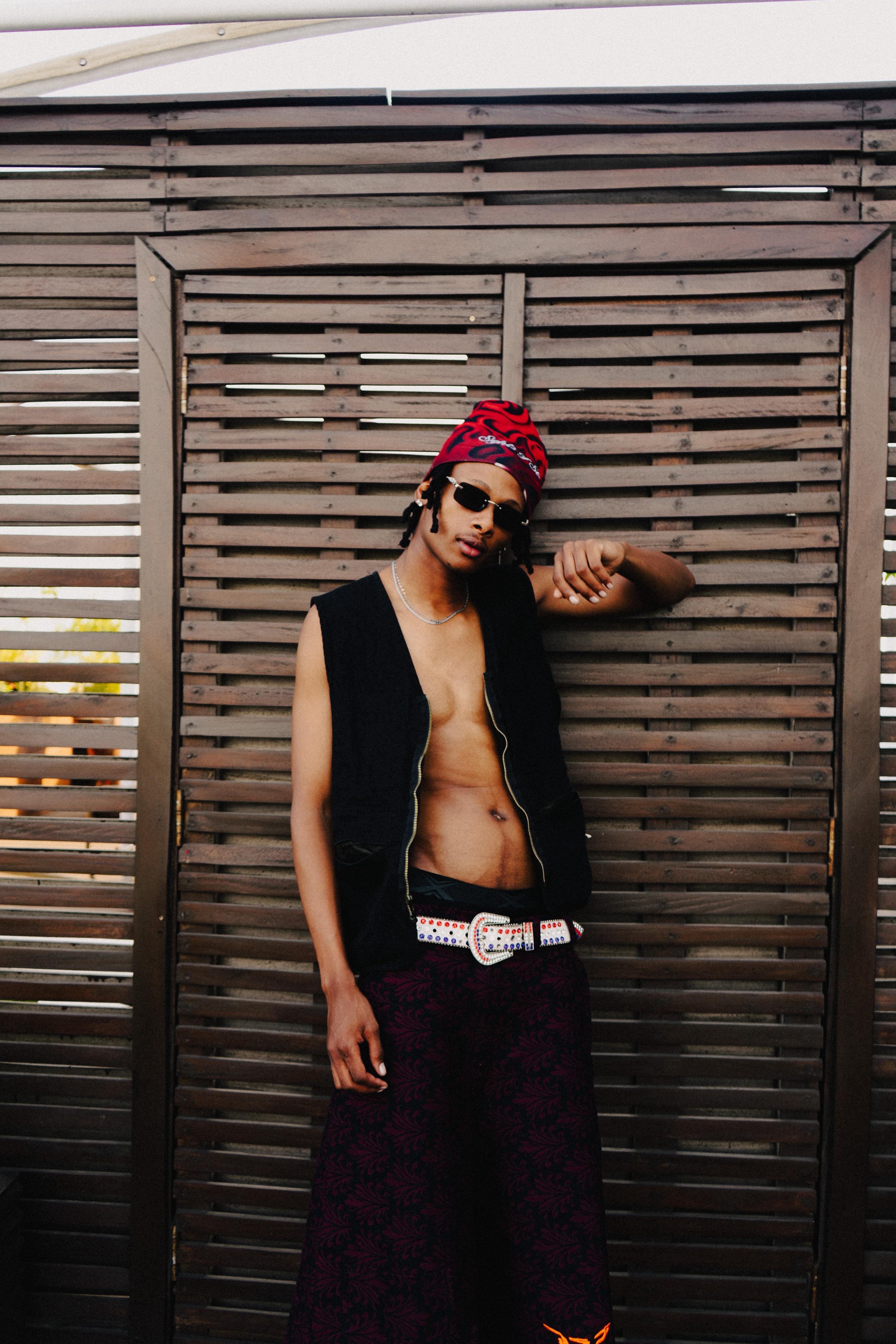
Northam sits quietly on the Limpopo map, the kind of place where ambition moves through people rather than through skyline or speed. It was in that stillness that Onkabetse “K-Zaka” Hlongwane first learned he could shape sound. He remembers being ten, in grade four, watching his parents treat his curiosity with seriousness rather than with contempt found within most Africans Parents. “Having support from my parents at a very young age made me realize that there’s nothing that I can’t be,” he says. His tone carries the calm of someone who has replayed that moment many times. The confidence did not arrive through bravado. It arrived because the most important people around him made it clear that his dreams were possible.
He talks about his name the way some people talk about a turning point. Childhood friends reduced Onkabetse to Kabo, and Kabo morphed into a string of stage names that never quite felt right. He laughs lightly when he recalls the evolution from Lil K to K-Money. Then, during a period when he was reading books about discipline and focus, a word stayed with him: Kaizen. “Kaizen is a Japanese word for constant self-expansion and never-ending improvement,” he says, settling into the thought as if he has internalized it for years. The K in Kaizen extended the K in Kabo, and the idea attached itself to his sense of identity. In his language, zaga means money, but the money in this context is not about material flash. It symbolizes reward tied to growth. “If you consistently grow, you’re going to eventually get the money,” he says.
That link between philosophy and creativity defines him. He considers himself rooted in spirituality, not in the mystical sense, but in the discipline of becoming better. “Improving yourself will only breed success,” he says. “The more you keep developing yourself, the more you attract opportunities that are beyond what your eyes could see.” He reads constantly. He studies routines. He journals. He meditates. He treats his mind like an instrument he has to keep tuned.
When asked how this worldview shapes his music, he speaks with clarity. “People ask me where I get my inspiration from and I get it from being the most level-headed I can be,” he says. He avoids alcohol when he is creating. He stays grounded in fitness and health. He needs exercise, meditation and journaling to feel aligned. Once he is in that space, fear loses its grip, and curiosity leads him toward new sounds. “When I wake up feeling like a champ because I put my money into myself, everything I touch becomes gold,” he says. The routine becomes a form of self-expansion. The music lives inside it.
Production came before DJing, even before beat-making. He started as a songwriter, then recording, then building beats from scratch. DJing entered naturally afterward. The layered path explains why his music often feels like multiple worlds stitched into one. You hear the composer before you hear the DJ.
“Galorizzy” is the clearest example. The beat itself is older than the song’s current life. He made it around 2022 and kept it in a link he used to send producers. He admired iPhxne DJ’s work and reached out with a simple message and a collection of beats. The collaboration grew slowly but steadily. Then, two or three years later, everything accelerated. iPhxne DJ played the beat during a studio session with Mavo. “The first beat he heard was the “Galorizzy” beat,” K-Zaka says. Within 24 hours, Mavo recorded and traveled back to Lagos. Davido added his part soon after. Once the record was finished, the momentum stopped belonging to any single person. “Collaboration is power,” he says. Each person carried the song forward from wherever they were, until the track became impossible to contain.
The surprise came when the release began to hit the internet. “When Mavo posted a snippet and I said I produced the song, my video went viral,” he says. The speed unsettled him at first. Every piece of content moved faster than the last. In Ghana, strangers stopped him and spoke about the record as if it had existed for months, not days. “I didn’t expect any of that,” he says. The experience felt guided. “It was definitely a God-orchestrated song.”
What made “Galorizzy” cross borders so quickly, in his opinion, is its fusion. His production leans toward an electro and EDM direction, shaped by synths and textures that are familiar to that world. But he pairs them with African drums and South African log drum patterns. The blend feels fresh without losing cultural grounding. “It’s got different elements of different genres that touch different people at the same time,” he says.
Travel sharpens this instinct. He does not travel to assert nationality. He travels to share sound. In Nigeria, he plays Nigerian records. In Ghana, he tests ideas he found elsewhere. His curiosity widens with each city. “I’m not just a South African advocate. I’m an African advocate,” he says. His sets reflect that. His productions reflect it too.
There was a moment in Ghana, shortly after the song released, when he felt something shift permanently. “I felt like I was on top of the world,” he says. Every venue played the record. People recognized him from viral clips. The reaction felt larger than anything he had imagined. The only thing that kept him grounded was routine. Gym in the morning. Meditation. Journaling. Structure became his anchor while life expanded faster than expected.
In conversations about hit-making, he challenges the idea that perfection drives virality. “A hit record is not the best sounding record,” he says. “It’s the best emotionally connected record.” For him, a hit is a song that a nation can sing because everyone feels something in common. Sometimes the connection is timing. Sometimes it’s energy. Sometimes it’s a story that people sense without being told. “You just need to be tapped into yourself,” he says.
As he looks ahead, he refuses to limit his collaborations. His A&R instincts push him to imagine every superstar in new sonic contexts. “I just want to give,” he says. He wants to walk into rooms across the continent and offer artists ideas that will stretch them. If everyone were placed in a room with him, he would find something new to spark in each person.
His latest project, released shortly after his birthday, centers on Afro House and carries emotional weight. It is tied closely to the final days he spent with his mother. The music reflects the tenderness of that period and the discipline that grew from it. He has more on the way. Songs made in Ghana, collaborations with KillBeatz, studio sessions with Mavo, moments scattered across countries and cities that now feed into a growing catalog.